Birch, Mycelium, and the Intelligence of Early Spring

Birch, Mycelium, and the Intelligence of Early Spring
Early spring begins quietly, below the surface, in the subtle coordination between light, soil, moisture, and time. Long before buds swell or birdsong grows louder, the Land is already reorganizing itself. This moment of early spring belongs to Imbolc, a threshold of warmth and protection that I explore more fully in my reflection on the meaning of Imbolc.
Across European landscapes, Birch has long been recognized as the tree that stands at this moment of turning. Slender and light-filled, it appears where disturbance has cleared the way, rising without force, orienting the eye and the body toward what comes next.
“Birch holds the initiation space for emergence”
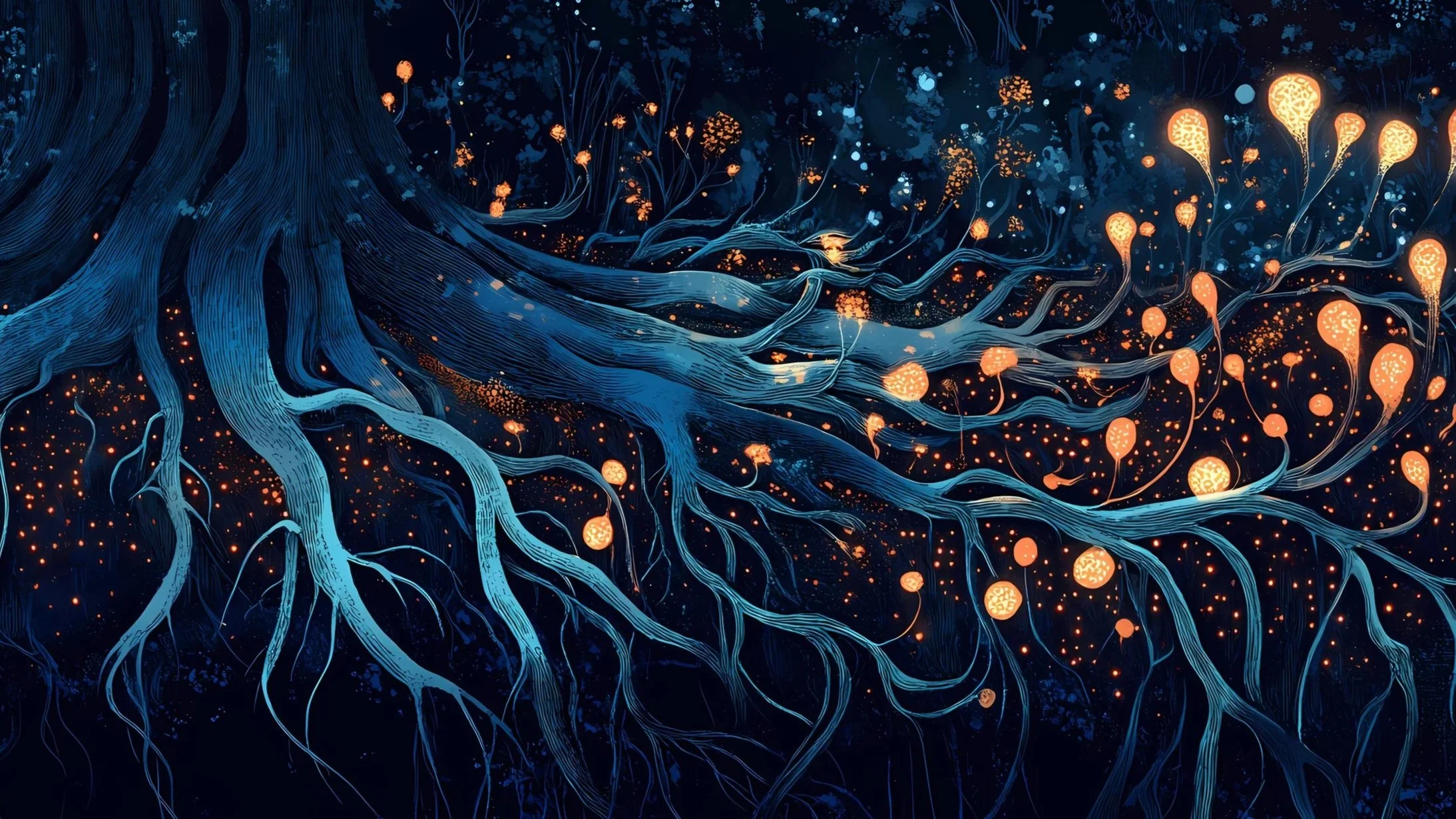
Beneath the ground, mycelial networks awaken alongside Birch roots, exchanging nourishment and information, carrying signals through the soil that shape what will emerge above it. This is living intelligence, relational and responsive, reminding us that renewal is never solitary. What begins in early spring is always a collaboration.
Birch at the Threshold of Spring
The Wheel of the Year is not a calendar to follow so much as a pattern to inhabit. It emerged from long attention to how life actually moves through the Land, through cycles of light and dark, contraction and release, emergence and return. For old European peoples, this was practical, embodied, and relationalmknowledge. Each season carried its own quality of attention, its own way of organizing life.
Birch enters the Wheel at the moment when winter’s stillness begins to loosen. Snow may still lie on the ground and frost may still hold the soil, yet something has shifted beneath the surface. Birch is often the first tree to return after disturbance, rising where fire, clearing, or collapse have opened space. Its slenderness and pale bark are functional responses to light, cold, and exposure.
“Birch offers orientation, not urgency.
”
At Imbolc, Birch offers orientation. Its vertical form provides a quiet reference point between Earth and sky, helping the body remember how to stand at a threshold without rushing forward. Birch teaches steadiness at the edge of change, showing how early movement can remain light, responsive, and grounded at the same time.
Birch as a Guide Between Worlds (Birke / Birch)
In old European traditions, Birch is a working ally in relationship with both human and Otherworld. Among Germanic peoples, seeresses known as the Walas or Völvas, along with the Hagazussen, the hedge-riders, worked with Birch as an orienting presence when moving between realms of perception.
Birch poles were raised inside ritual tents or carried into open circles as vertical reference points. They anchored the body between Earth and sky, offering the nervous system a steady axis while awareness traveled beyond ordinary boundaries.Birch helped practitioners move outward and inward without losing the thread that led back home.
Its sap marked the first circulation of the year, the moment when life began to flow again through the Land. That movement was felt as much in the body as it was observed in the forest. Birch taught how to cross thresholds without abandoning ground, how to remain oriented while perception widened, and how to return intact from liminal states rather than becoming untethered within them.
What Lives Beneath the Ground
Birch thrives in community. What may appear slender and solitary above the soil is sustained by dense relationship below it. The roots of Birch form living alliances with fungi, most notably with the fly agaric, the Fliegenpilz, Amanita muscaria. This relationship is a long-standing ecological partnership through which nutrients, information, and stability move back and forth between tree and fungus.
“Renewal moves through relationship rather than isolation.”
The mushroom grows as a mycorrhizal partner in direct contact with Birch roots, extending the tree’s reach into the soil while receiving sugars in return. Together they form a system that senses changes in moisture, temperature, and disturbance long before those shifts become visible above ground.
Long before humans spoke of intelligence or networks, the Land demonstrated them here. Birch and fungus showed how early spring depends on cooperation rather than dominance, and how renewal moves through relationship rather than isolation.
Before There Were Maps, There Were Roots
Long before there were doctrines, calendars, or written instructions, knowledge moved through contact. People learned by returning to the same places, season after season, and paying attention to how life responded.
“The forest was a teacher whose lessons unfolded slowly through repetition and relationship.”
For the Walas and hedge-riders of the old European lands, learning happened through sustained intimacy with specific trees, soils, and cycles. Birch taught by being returned to at the same point in the year, again and again, until its timing lived in the body rather than the mind.
This way of knowing kept spirit embedded in ecology. Movement between worlds was grounded in place, anchored by roots that held memory and continuity. The Land offered coherence over time, through attention, patience, and repeated listening, not all at once in a clear, bright "download".
When Sound Awakens What Lives Below
Contrary to some popular anthropological beliefs, seasonal gatherings in early spring were about so much more than just human morale. Sound, movement, and rhythm were understood as ways of speaking with the living systems beneath the ground. Drumming, singing, stamping feet on frozen soil — these were ways of entering conversation with the Living Land.
Modern ecology has begun to confirm what ancestral practice already knew. Mycelium responds to vibration. Sound travels through soil, stimulating fungal activity and growth. When people gathered at seasonal thresholds like Imbolc, their voices and movements sent signals into the Land, encouraging circulation and wakefulness in the networks that support early spring life.
In this way, celebration was participation in an ongoing relational conversation, not performance. Human bodies, fungal networks, trees, animals, and weather were moving within the same field of relationship, each responding to the others. Early spring began with resonance occurring where feet meet Earth.
Celebration as Ecological Participation
When ritual is understood this way, it stops being considered symbolic and becomes practical. Sound, warmth, and movement are forms of nourishment. They feed the mycelial web, which in turn feeds plants, trees, animals, and people. What looks like culture from the outside is ecology in motion from within.
Early spring rituals acknowledged that life depends on circulation. When humans gathered to sing, drum, or move together at seasonal thresholds, they were participating in the same exchanges already happening between roots, fungi, water, and soil. Energy moved because relationship was being tended.
This is why silence and sound both mattered. Too much noise disrupts. Too little leaves systems dormant. The old practices worked because they were timed, restrained, and responsive. Celebration happened when the Land could receive it. In that exchange, early spring found its footing.
The Forest Does Not Speak All at Once
Early spring unfolds as a sequence of voices, each carrying a different quality of attention. Birch opens the year with lightness and initiation, not as urgency, but as permission to begin again. Beech follows with inward listening, offering clarity that comes through stillness rather than thought. Oak brings structure and shared order, grounding growth in responsibility to the whole. Linden restores warmth and belonging at the heart of summer, while Yew holds the long view, carrying death, continuity, and the threshold beyond time.
The relationship with a Forest shows us way of listening that unfolds through contact. The trees do not speak all at once because the body cannot receive everything at once. Each voice arrives when the season, the Land, and the nervous system are ready.
This understanding lives strongly in the work of Wolf-Dieter Storl, who approaches tree wisdom as relationship rather than symbolism. The trees teach not through meaning, but through presence, repetition, and time spent listening.
Learning the Year Through Relationship, Not Knowledge
Tree wisdom, as is all Land based wisdom, was learned through repeated contact, through walking the same paths year after year, touching bark, noticing scent, watching how light changed beneath different canopies. Knowledge arrived slowly, shaped by season, weather, and the state of the body.
This kind of learning builds trust rather than certainty. It teaches when to approach and when to wait, when growth is supported and when restraint is required. The forest becomes a teacher not because it explains, but because it responds. Attention deepens through relationship, and understanding emerges without being forced.
When the year is learned this way, timing begins to feel reliable again. The body recognizes which voices belong to this moment and which will come later. In that recognition, the Wheel stops being an idea and becomes a lived rhythm, one that continues to teach long after names and concepts fall away.
Birch Hands the Work Forward
Birch opens the door at the beginning of the growing season and then steps aside. Its work is to make continuation possible. Early spring depends on cooperation, on what moves quietly below ground supporting what will eventually rise into view.
“Nothing begins alone.”
This is the deeper teaching Birch offers at Imbolc. Nothing begins alone. The first stirrings of life rely on networks already in place, on relationships that have been tended long before anything is visible. What looks like fragility is supported by depth and what appears new is carried by memory.
Birch reminds us that beginnings are shared events. When we align with this rhythm, effort softens into participation. We stop trying to carry the future on our own and learn instead how to step into what is already unfolding, supported by the Land and by time itself.
Returning to the Hearth
The meaning of Imbolc is something we return to, whenever life asks us to slow down enough to listen. Beneath the urgency of modern life, the same quiet rhythm is still moving. The Land remembers how to warm what is fragile and shelter what is becoming.
When we remember this rhythm, the body responds. Breath settles. Attention softens. What once felt like striving begins to feel like participation. Creation stops being something we push toward and becomes something we stay present with, one small act of care at a time. This is the hearth work of Imbolc, the steady warmth that allows life to continue its slow, patient unfolding.
If you’d like to explore this rhythm more deeply, on January 30, I’m offering a free 90-minute live Imbolc gathering called Imbolc — Remembering the Heart’s Desire.
We’ll enter this season together as a dreaming threshold, where what matters most has not yet taken shape, but is already asking for warmth and protection. Through seasonal teaching, guided reflection, and embodied listening, we’ll explore how desire remembers itself when pressure falls away.
This is an invitation to listen rather than decide, to warm rather than push, and to let what is forming be held long enough to trust its timing.
You can register here: https://www.romarlen.com/imbolc-dream
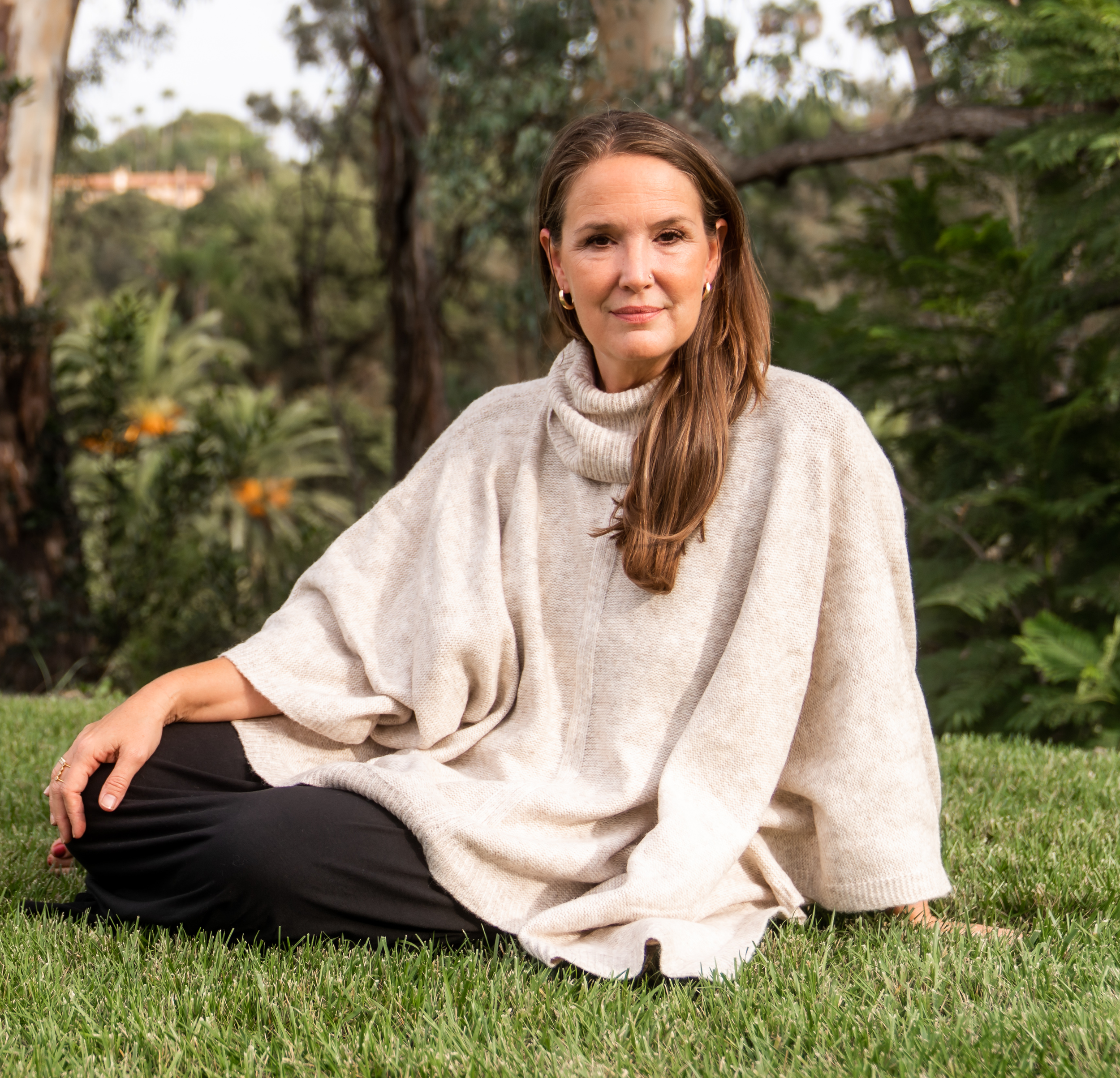
Ro Marlen is a wisdom teacher and somatic guide for sensitive, spiritually attuned Thresholders navigating burnout and relational wounding, often arriving in the body as chronic illness, in a culture that has forgotten how to belong.
Her work restores the Ground beneath healing: the remembrance that your body is Land, your lineage is living, and the world you are healing within is as sentient as you are.
She is the founder of The Sacred Evolutions Wisdom School. Through Rewild Yourself and the wider body of work at SEWS, she offers a living path back to what the Overculture worked hard to make you forget, and forward into what you are still becoming.
Her writing invites you to slow down, listen through the body, and remember the intelligence that has been living you all along