Frau Holle and the Winter Solstice: Remembering the 12 Nights of Winter
At the Winter Solstice, our ancestors said the sun died. For three days it appeared to rest below the horizon, unmoving, before beginning its slow ascent once more. This moment marked the turning of the year—the great pause between breaths when the long inhale of autumn came to its end, and the exhale of the new light had not yet begun.
They watched this carefully because it told them how to live. The energy of the Earth changes direction at this time. Everything living turns inward. Roots draw deeper into the soil. Animals seek shelter. The Land settles and waits. It is not an empty stillness but a fertile one—full of life quieting enough to listen.
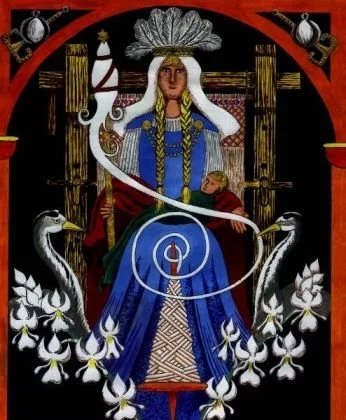
Frau Holle- Winter’s Goddess
In the old villages, fires were tended through the longest nights to keep the spark alive while the sun traveled the underworld. People made offerings to the elements, to the ancestors, to the unseen. Smoke was prayer and flame was promise. The light had to be kept, not only in hearths but in hearts.
This season belongs to Frau Holle, the winter face of the Great Goddess. She shakes her featherbed, and snow falls. She walks with the unborn souls and the ancestors, guiding them through the dark. Under her care, the world rests. The soil gathers its strength for what will come.
Even if we no longer speak her name, our bodies still know her rhythm. When the days shorten, we slow down too. We clean. We bake. We light a candle. We listen for what moves underneath the noise of the world.
At the Winter Solstice, everything living turns toward rest. The Land is breathing in again. We are meant to do the same—settle, listen, and let what is unseen begin its quiet work inside us.
The Ancestral Origins of the Winter Solstice
Long before it was called Christmas, the Winter Solstice was celebrated as Yule—a festival of light reborn from darkness. Our ancestors watched the sun appear to die at the Solstice and rise again three days later, and they knew that more than light was returning. It was the living consciousness of the world coming back into motion.
They marked this renewal in ways that kept both the body and spirit attuned. The Yule Log offered warmth against the cold and kept the inner flame, the light of awareness, alive while the sun journeyed through the underworld. It burned through the 12 Nights of Winter, each night a portal of dreaming, a threshold between worlds where ancestors could be heard and future visions could take root.
The Advent Wreath, once woven of evergreen boughs and lit by four red candles, was a symbol of life’s endless cycle. The circle represented eternity, the ever-turning rhythm of life, death, and renewal. The green of the branches spoke of the heart of the Earth—life that endures through darkness. The candles honored the four directions, the elements, and the red ribbon spoke of the blood that binds spirit to body.
The Goose, the Spindle, and the Stars were sacred to Frau Holle, the winter face of the Great Goddess. Each one held a teaching. The goose was her companion, guiding souls through the dark sky; the spindle was her instrument of destiny, spinning life’s thread; the stars were her sparks of renewal, scattered across the long night. These were reminders that creation and care were one act—that to spin, bake, or weave was to participate in the ongoing making of the world.
Over centuries, these practices were absorbed into Christian ritual. The birth of the sun became the birth of the Son. Frau Holle, the gift-giver who walked the land in midwinter, was recast as St. Nicholas. The sacred nights became “holy nights,” and the Yule log became the Christmas fire. Yet the old meanings are still there, quiet beneath the newer layers, waiting to be remembered.
Heide Goettner-Abendroth writes that in matriarchal cosmologies, creation is a living rhythm, where light continually rises out of darkness and returns again. Wolf-Dieter Storl reminds us that the folk traditions of Europe, though renamed, remain rooted in animism: the understanding that all of nature is alive, responsive, and in relationship with us.
These days were holy in practice, technologies of relationship that helped people remember how to live in rhythm with the Land.
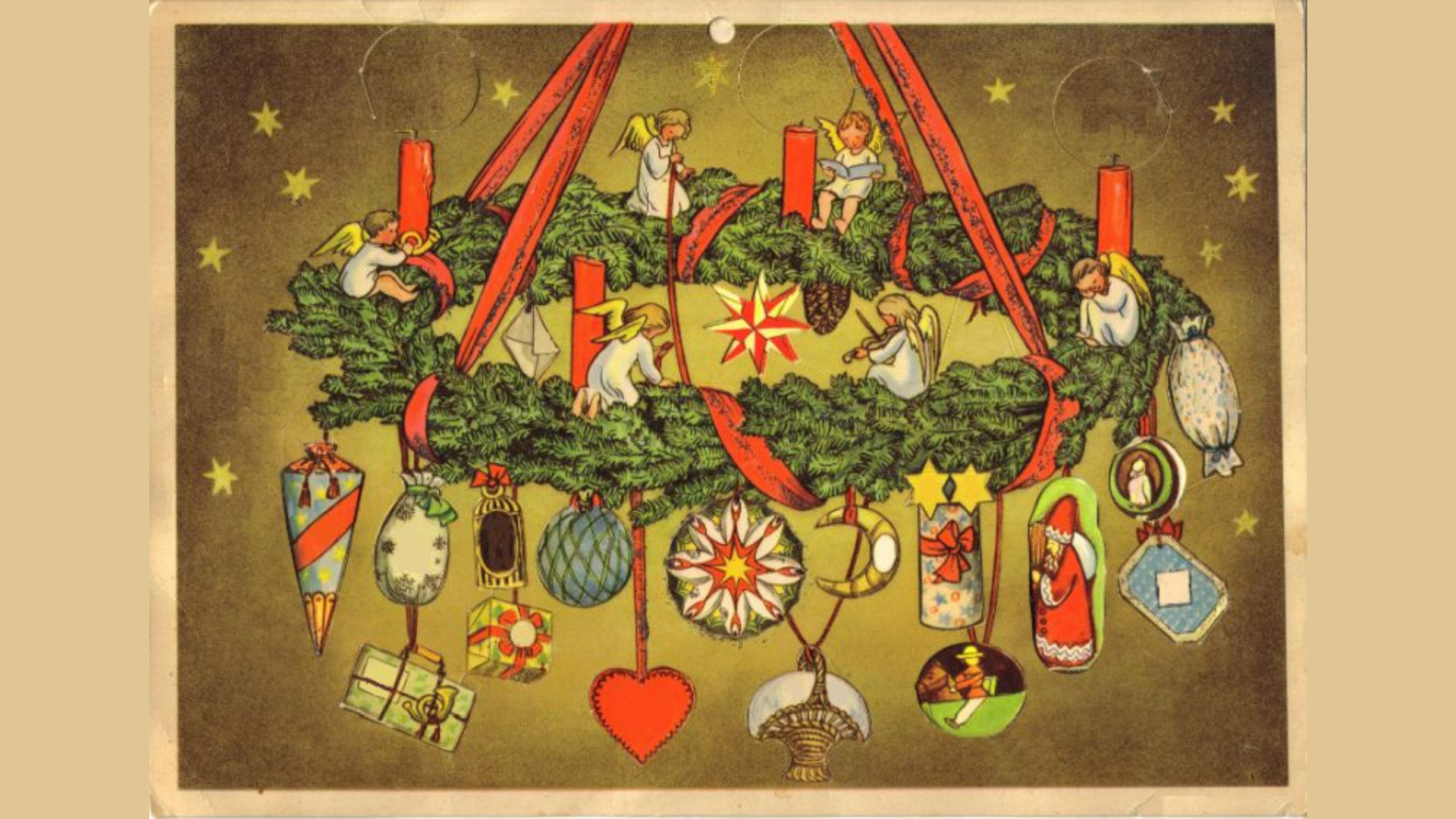
19th century Advents Wreath
Even now, when we bake or weave or hang evergreen boughs in our homes, we are speaking an old language through our hands. These gestures reach backward and forward at once. When we remember why these shapes—stars, geese, spindles, wreaths—were made, something in us begins to relax. The mind quiets, the body listens, and in that state, new understanding can rise through old forms.
This is the way with all cultural activities rooted in the home—baking, brewing, spinning, carving, singing. These acts were ways of entering relationship with time, place, and spirit. To revive them is not to glorify the past or to wish ourselves back into an age that no longer exists. It is to remember forward—to bring the intelligence of our ancestors into the modern world where it still belongs.
When we approach these acts with awareness, they become doorways. The scent of dough rising, the rhythm of kneading, the hum of the spindle—all open the same pathways our well-ancestors once walked. Through this, we begin to restore a way of being that is both ancient and necessary: one that values care, continuity, and relationship over speed and consumption.
In forgetting these ways, we have forgotten the spiritual tending that kept the world in balance. Frau Holle once governed the weather and the seasons, guiding the souls of the unborn and the ancestors. When humanity lost its rhythm with her, we also lost our sense of responsibility to the Land itself. I sometimes wonder if our present ecological crises—the unraveling of climate, the hunger for more—are the outer symptoms of that inner neglect.
To re-enter this rhythm now is to take part in repair. It is to live in a world that is again humane for humans, where care extends beyond our species and back into the soil, the waters, and the air that sustain us all.
Practicing Cultural Remembrance
You could begin with something simple. Maybe dough, flour, warmth. The recipe doesn’t matter as much as the attention you bring to it.
As your hands work, notice the sound of the bowl against the table, the texture changing under your palms. Your breath starts to match the rhythm of your movements. Thought falls away; awareness widens.
This is what your ancestors knew. The state that arises when the hands lead and the mind follows—the soft focus of creation. In that space, memory becomes porous.
You shape what they once shaped, and in that rhythm, ancient knowing remembers itself through you.
Each form carries meaning. The goose for guidance, the spindle for life’s thread, the candle for the flame that never went out, the star for the light’s return. Making them again is a quiet act of repair, not nostalgia. It’s how we remember forward, bringing the intelligence of those who came before into a time that needs their steadiness.
When you move this way—slow, present, aware—care returns. The pace of the world softens. You begin to sense that reverence isn’t rare; it’s natural.
Ask yourself:
What happens in your body when you move at the speed of care?
What wants to be tended through your hands this season?
Where might old wisdom be waiting for you to touch it back to life?
Collective Reflection: Forgetting and the World’s Imbalance
When we look around at the state of the world, it can be tempting to see collapse as something new. But what if it began when we forgot how to tend?
When we stopped listening to the wind as a being, when we stopped making offerings to the river, when the name of Frau Holle was turned into a fairy tale, something vital slipped from our hands. The rituals that once held the balance between humans and the living world fell away, and the weather—the body of the Earth—lost its dialogue with us.
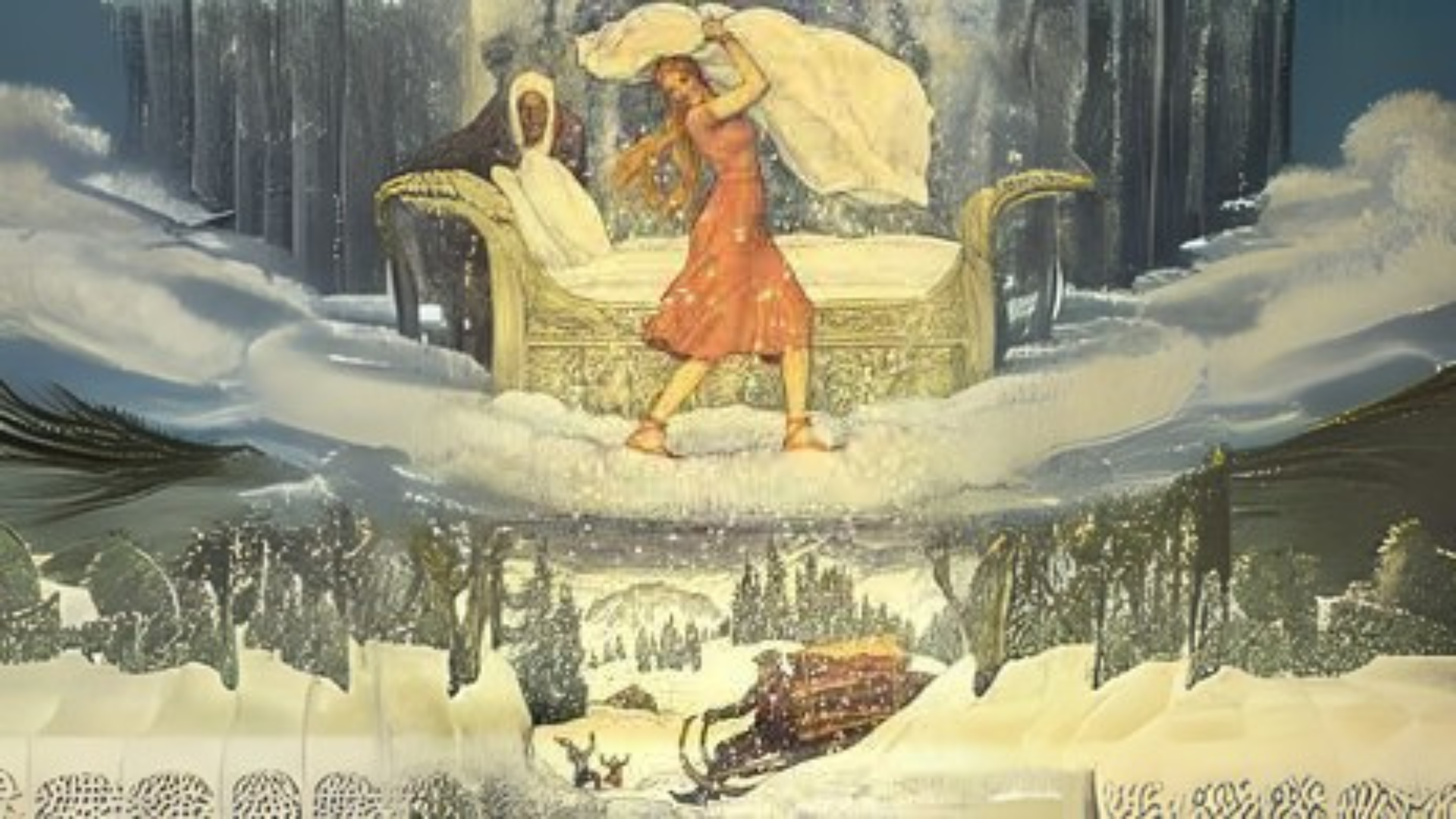
Frau Holle and the ancestors tend the weather
When we stopped tending the goddess of weather and harvest, perhaps the weather itself began to cry out.
Rune Hjarnø Rasmussen writes that ancestral reciprocity is the foundation of animist cultures: the recognition that we live inside a web of exchange. To take without giving, to consume without ceremony, breaks that web. And we can see the tearing everywhere—melting ice, scorched fields, waters rising beyond their banks.
This isn’t about guilt. Guilt keeps the body frozen. What we need now is remembrance. A return to relationship that begins in care. The point is not to go back, but to restore the capacity to listen forward—to meet the Land and its beings as kin again.
Imagine what it might mean to be a good ancestor. Not in theory, but in practice. To move through a day in a way that leaves more balance behind you than before you arrived. To tend light, soil, breath, and story with the same care your great-grandmothers gave to dough and thread.
Our small acts—lighting a candle, baking bread, speaking gratitude to the wind—may not stop the storms. But they change the field of relationship in which we live. They remind the world that we remember her. And perhaps, in that remembering, the weather might soften again.
Ritual Gestures for the Modern Day
You don’t need much to honor the Winter Solstice—only attention, a little time, and willingness to be present with the turning of the light.
You might light a single candle each night of the 12 Nights of Winter, watching the flame change as your own rhythm changes. Let it burn while you eat, read, or sit in quiet. The point isn’t the fire itself, but your relationship to it—the way it steadies your breathing, the way it reminds you that light survives inside darkness.
You could pour a small bowl of milk or a spoon of honey and set it outside for the Land or your ancestors. A gesture of reciprocity. A way of saying, I remember you.
Some nights you may feel called to burn mugwort or juniper, to let the smoke wander through your home, clearing the old, making space for what is coming. Notice how the scent settles you. Let it move through corners and linger in the folds of fabric.
If you have a fireplace or even a single candle, you can tend it through the long night. Watch how it flickers and changes, how it lives by breath. Let that be your meditation: the simple tending of flame, the reminder that consciousness itself is a light that must be cared for.
The point isn’t to replicate the past, but to return to relationship. Every act of care is ceremony.
When you bring these gestures into your days, the old ways aren’t distant—they’re alive again, shaping how you move, how you give, how you rest. And in that quiet remembering, the world begins to breathe with you.
Remembering the Stillpoint
In the end, the Winter Solstice asks for nothing extravagant from us. Only our presence. Only that we pause long enough to feel the Earth stop, to notice that even the Sun rests before it rises again.
When we follow that rhythm—root, rest, return—we begin to move in tune with life itself. Each year, this dark pause gives us another chance to listen for what’s stirring beneath the surface: the dream of who we are becoming.
These nights are full of true magic. They are the fertile dark in which creation gathers strength.
If you feel the pull to tend this pause with others—to listen, dream, and let the new cycle gestate within you— I invite you to come join me for The 12 Nights of Winter Immersion.
For twelve nights between Solstice and the first dawn of the new year, we gather to remember what our ancestors always knew: that light is born from stillness, and destiny begins in the dark. Together, we’ll mark each night with candlelight, dreamwork, and gentle ritual—simple acts of care that return us to the rhythm of the cosmos.
You can learn more and join us here → The 12 Nights of Winter
This is how we return to relationship, remembering the old agreement between body and Earth, light and dark, you and the world that holds you.
The wheel turns. The Sun will rise again. And somewhere inside that quiet turning, so will you.
Reflective Questions
What part of you is ready to rest into the dark?
What is quietly gestating beneath the surface of your life?
How might you move through the coming year in rhythm with the Earth’s own breathing?
What small act of care can become your offering to the returning light?